What Is Reseller Hosting?
Reseller hosting is a type of web hosting service that allows a user to purchase hosting resources from a provider and resell them to other users as separate hosting accounts.
Reseller hosting lets you run your own mini-hosting business without owning physical servers or building a data center. The original hosting provider supplies the server infrastructure, while the reseller packages, sells, and manages hosting services under their own brand.
Reseller hosting provides an easy way to enter the web hosting business because it lowers the technical and financial barrier to selling hosting services. Agencies, freelance web developers, web designers, and IT consultants commonly use reseller hosting when they want to sell hosting services to clients alongside website design, website maintenance, search engine optimization (SEO), email setup, or online business support. Reseller hosting differs from regular web hosting because regular web hosting is typically used to host the buyer’s own websites, while reseller hosting is used to create and manage separate hosting accounts for clients.
How Does Reseller Hosting Work?
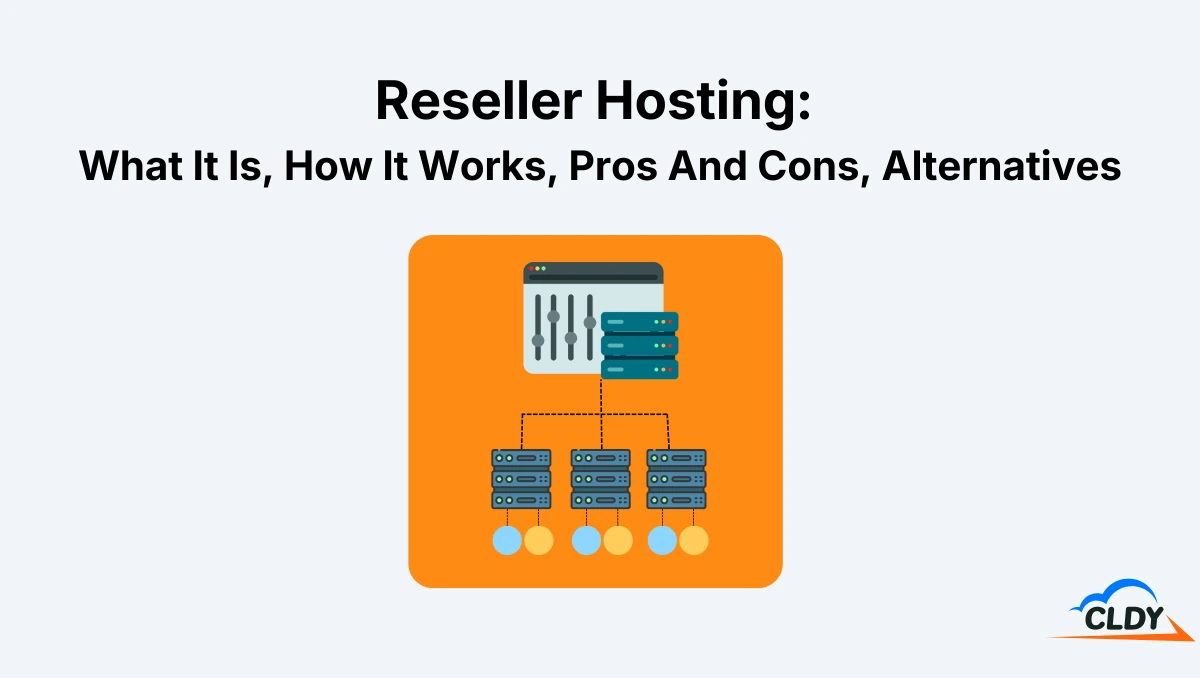
Reseller hosting works through a division of responsibilities between the parent hosting provider and the hosting reseller. The hosting provider (also known as parent hosting company) handles the server-side environment. This includes the physical servers, data center operations, network connectivity, hardware maintenance, server uptime, security patches, core software updates, and backend technical systems. The provider also gives the reseller access to a reseller control panel for creating and managing client accounts.
The hosting reseller handles the customer-facing side of the service. This includes creating hosting packages, setting prices, allocating resources, managing client accounts, and providing first-level customer support. The reseller works directly with clients, while the parent hosting provider remains responsible for server-level operations.
The reseller buys a large block of server resources from the parent hosting company, then divides the hosting resources from their reseller plan into separate accounts for clients. Each client account has its own login details, control panel access, storage limit, bandwidth allowance, email features, and domain management tools. Clients manage their own websites while the reseller oversees the accounts from one central dashboard.
Reseller hosting works as a three-party arrangement between the parent hosting provider, the reseller, and the client. The parent hosting company sells larger hosting plans to resellers. The reseller gets an easy way to enter the web hosting business and run a mini-hosting business under their own brand. The client gets hosting that is often bundled with website design, maintenance, email setup, or technical support.
What Are The Benefits Of Reseller Hosting?
The 5 main benefits of reseller hosting are listed below.
- Low Startup Costs: Low startup costs means resellers enter the web hosting business without the expenses of buying physical servers, leasing data center space, or hiring a full infrastructure team. Resellers instead rent hard drive space, bandwidth, and server capacity from a larger hosting provider at wholesale prices then resell them at a profit.
- Custom Hosting Packages: Custom hosting packages means resellers create plans that match their clients’ specific website needs. In reseller hosting, you can offer small plans for basic websites, larger plans for business websites, or bundled plans that include hosting, email, website maintenance, backups, and technical support.
- Provider-Backed Infrastructure: Provider-backed infrastructure means resellers offer hosting services using the server capacity, reliability, and technical systems of an established hosting provider. The parent provider manages hardware, connectivity, uptime systems, security patches, software updates, and core maintenance while the reseller focuses on clients, pricing, branding, and added services.
- Client Account Control: Client account control means resellers create, manage, suspend, upgrade, and allocate resources to client hosting accounts from a control panel. Reseller hosting plans typically include control panels like WHM and cPanel to help resellers manage domains, storage limits, bandwidth, email accounts, and usage across multiple websites.
- Flexible And Scalable Service Structure: Flexible and scalable service structure means resellers adjust hosting plans as their client base grows. This lets them add more accounts, modify packages, upgrade resources, or move clients into higher plans when websites need more storage, bandwidth, or account capacity.
CLDY is a web host offering reseller hosting plans for users who want to manage multiple client websites under their own business structure. Its reseller hosting plans allow agencies, developers, and digital service providers to sell hosting under their own brand while relying on CLDY’s cutting-edge hosting infrastructure for the server environment.
What Are The Limitations Of Reseller Hosting?
The 6 main limitations of reseller hosting are explained below.
- Restricted Server Access: Restricted server access means resellers usually do not get root access or full server-level permissions. In reseller hosting, resellers manage client hosting accounts while the parent hosting provider controls the main server configuration, operating system, security settings, and backend software. This limits advanced software installation, custom server settings, and deep performance tuning.
- Limited Resources: Limited resources means CPU (Central Processing Unit), memory, storage, bandwidth, databases, and email capacity are finite. In reseller hosting, your clients' accounts share the same overall resource pool, so heavy usage from one or more websites affects available capacity.
- Scalability Is Often Limited: Scalability limitations mean growth usually depends on upgrading to a larger reseller plan. Reseller hosting supports moderate client growth but is less flexible than other types of web hosting when multiple websites need more CPU, memory, or bandwidth at the same time.
- Misleading Low Monthly Pricing: Misleading low monthly pricing means the advertised plan price does not always reflect the full cost of running a hosting business. In reseller hosting, you still need to account for billing tools, client support time, backups, security add-ons, domain services, email support, and future upgrade costs.
- Dependence On The Parent Hosting Provider: Dependence on the parent hosting provider means the reseller’s service quality is tied to the provider’s infrastructure, support, uptime, pricing, and policies. Reseller hosting's server maintenance schedules, acceptable use rules, security practices, and platform restrictions all affect your own clients.
- Client Support Responsibility: Client support responsibility means the reseller usually handles the customer-facing side of hosting support. The parent provider in reseller hosting handles server-level issues, but clients still expect you to answer questions about setup, website access, email accounts, downtime, billing, and resource limits.
What Are The Reseller Hosting Alternatives?
Reseller hosting alternatives refer to web hosting services that allow users to host or manage multiple websites without using the account resale structure of reseller hosting. These alternatives are better suited for users who need more direct server control, stronger resource allocation, better scalability, or higher performance across multiple websites.
The 2 main reseller hosting alternatives are Virtual Private Server (VPS) hosting and cloud hosting. VPS hosting provides dedicated virtual resources, stronger account isolation, and more server control, making it a strong alternative for users who need higher performance or more technical flexibility for their websites than reseller hosting provides. Cloud hosting uses virtual servers across a wider cloud infrastructure to improve reliability, reduce dependence on one server, and keep websites more stable during traffic changes or server disruptions.
Reseller Hosting Vs. Shared Hosting
The key difference between reseller hosting and shared hosting is their beginner-friendliness. Beginner-friendliness refers to how easy a web hosting type is to set up, understand, and manage without advanced technical knowledge. Reseller hosting is moderately beginner-friendly but requires technical knowledge to create hosting packages, manage client accounts, assign resources, and handle customer-facing hosting tasks. Shared hosting is highly beginner-friendly because shared plans usually come with predefined resources and a simple, ready-to-go control panel to get their own websites online. Use reseller hosting if you are comfortable managing multiple hosting accounts and want to sell hosting services to clients. Use shared hosting if you want the simplest way to launch one website with minimal setup and fewer management tasks.
Reseller Hosting Vs VPS Hosting
The key difference between reseller hosting and VPS hosting is their performance. Performance refers to how well the host supports website speed and uptime. Reseller hosting provides moderate performance because multiple client accounts share resources within a larger reseller hosting environment. The reseller assigns resources to different accounts, but usually has limited control over deeper server settings and performance tuning. VPS hosting provides stronger performance because it gives users dedicated virtual resources, stronger account isolation, and more direct control over server configuration. Use reseller hosting if you want to sell hosting services to clients and your websites have moderate traffic and resource needs. Use VPS hosting if your websites need higher speeds, more resources, and custom performance tuning.
Reseller Hosting Vs Cloud Hosting
The key difference between reseller hosting and cloud hosting is their reliability. Reliability refers to how consistently a hosting environment keeps websites available, stable, and responsive during normal use, traffic changes, and server issues. Reseller hosting typically uses shared server infrastructure, so reliability depends on how well that shared environment manages stability, resources, and redundancy across multiple reseller and client accounts. Cloud hosting offers superior reliability because its network of servers reduces dependence on one physical machine. Use reseller hosting if you want to sell hosting services to clients whose websites have steady traffic and standard uptime needs. Use cloud hosting if your website needs stronger availability, better fault tolerance, and more stability during traffic changes or server disruptions.
Reseller Hosting Vs. Dedicated Hosting
The key difference between reseller hosting and dedicated hosting is their control and access. Control and access refers to how much authority a user has over server settings, permissions, software configuration, resource management, and backend customization. Reseller hosting has limited control and access through WHM because resellers only manage client accounts and hosting packages, while the parent hosting provider controls the main server environment. Dedicated hosting provides root access and server-level customization because one user gets full administrative access to the physical server. Use reseller hosting if you want to manage client hosting accounts under your own brand without handling server technicalities. Use dedicated hosting if you need deep server permissions, custom configurations, and full control over how the hosting environment is built and maintained.
Reseller Hosting Vs. WordPress Hosting
The key difference between reseller hosting and WordPress hosting is their specialization. Specialization refers to how closely a web hosting type is built for a specific platform, business use, or website need. Reseller hosting is specialized for selling and managing hosting services because it allows users to create client accounts, assign resources, and offer hosting under their own brand. WordPress hosting is built specifically to host sites built with the WordPress platform because it includes WordPress-focused tools and performance optimizations. Use reseller hosting if you want to manage hosting for different clients or website types from one reseller account. Use WordPress hosting if your main priority is running WordPress websites with hosting features designed to support that platform.