What Is Web Hosting?
Web hosting is an internet service that stores website files on an online server in order to make them accessible to visitors. These website files include HTML (HyperText Markup Language) pages, images, videos, databases, and scripts which make up the site’s content, structure and functionality.
Using web hosting is the internet equivalent of renting a home for a website. The website owner agrees to rent server space from a web host instead of owning and maintaining the physical server directly. The web host provides its customers with the physical servers, network connectivity, server software, and supporting infrastructure needed to keep the hosted website available online. The web host helps keep the server running continuously, processes visitor requests, and delivers the correct website files to users. This allows website visitors to access the website whenever they enter its domain name through their web browser.
Who Uses Web Hosting?
Web hosting is used by individuals, businesses, and organizations that want to publish websites or applications on the internet without managing the full technical infrastructure themselves.
Individuals use web hosting for personal blogs, portfolios, resume websites, hobby projects, and freelance services. Freelance artists, writers, and designers often rely on web hosting to build an online presence, and share content with audiences worldwide. Developers use web hosting to test, deploy, and maintain websites, applications, and client projects.
Businesses use web hosting for company websites, online stores, booking systems, customer portals, and web applications. Small businesses often use more affordable shared forms of hosting, while larger companies procure powerful hosting servers to support maximum performance for mission-critical sites.
Organizations like schools, nonprofits, and government agencies use web hosting to publish information, manage resources, accept registrations, collect donations, and communicate with the public online. Web hosting supports any person or entity that needs a reliable online location for publishing, managing, and delivering website content.
How Does Web Hosting Work?
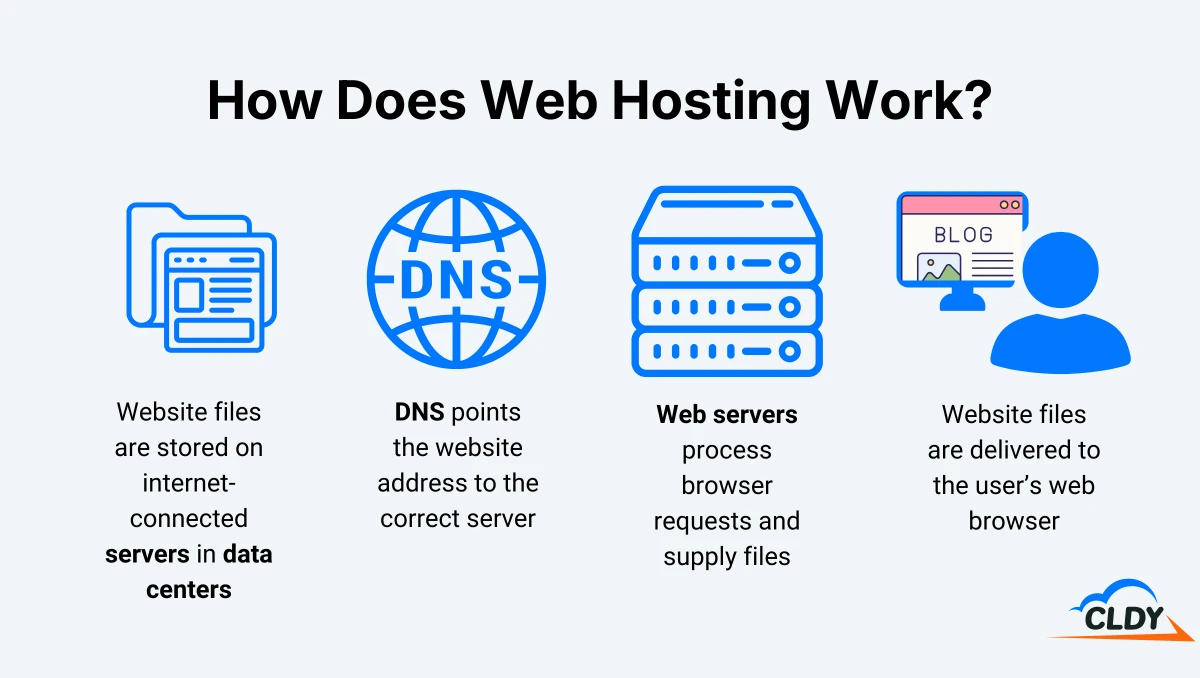
Web hosting works by storing website files on an internet-connected server and delivering those files to visitors. This involves five components working together.
The first is a data center, which is a facility that contains physical servers, networking equipment, power systems, cooling systems, and internet infrastructure. The second are the servers within the data center that are used to store the files and databases that make up websites. The third component is web server software. Web server software runs on the hosting server and manages communication between the server and website visitors. It receives browser requests, identifies the requested website files or resources, and sends the correct content back to the visitor’s browser.
The fourth component is DNS (Domain Name System). DNS connects the website’s domain name to the hosting server by translating the domain into the server’s IP (Internet Protocol) address. This allows the browser to locate the correct server when a visitor enters the website’s domain name. The fifth component is data transfer between the hosting server and the visitor’s browser. The browser requests website content, and the server sends the required files across the internet so the browser can display the webpage.
A management or control panel supports the hosting environment by giving users a graphical interface for managing their hosting settings. Web hosting configuration varies by hosting type. This means the server setup, resource allocation, control level, scalability, and management responsibilities change depending on the hosting environment chosen.
What Is A Server?
A server in web hosting is a powerful, continuously connected computer that stores, processes, and delivers website data to users over the internet. The server is the machine responsible for keeping website files such as HTML documents, images/videos, and application data accessible, responding to the user’s request by processing it through web server software, and sending the requested content back to the user’s device. These servers use resources such as CPU (Central Processing Unit), RAM (Random Access Memory), storage, and bandwidth.
Who Owns And Manages A Web Hosting Server?
A web hosting server is owned and managed by a web hosting provider. A web hosting provider is a company that rents out the infrastructure, hardware, software, networking, and technical services required to keep customer websites online. Web hosting providers either own physical servers directly or lease from large-scale data center operators or cloud infrastructure companies. The web hosting provider is responsible for maintaining server hardware, replacing failed components, monitoring uptime, configuring networks, applying security updates, and managing server performance.
Users manage certain parts of the server environment themselves depending on the type of hosting being offered. Basic types of hosting give users limited control, while others provide root or administrative access that allows for advanced server configuration.
Web Hosting Vs Domain Name
The difference between web hosting and a domain name is that web hosting provides the server space where a website’s files are stored, while a domain name provides the address visitors use to find that website online. Web hosting is responsible for storing website content and making it available through a hosting server. A domain name does not store website files. It points visitors to the correct hosting server through DNS (Domain Name System), which translates the domain into the server’s IP (Internet Protocol) address. Web hosting and a domain name are often purchased together from the same provider, but they are separate services with different functions.
What Are The Different Types Of Web Hosting?
Types of web hosting refer to the different ways hosting providers allocate server resources and management environments to websites. Each web hosting type uses a different server setup, resource distribution model, and scalability structure. The 5 types of web hosting are shared hosting, Virtual Private Server (VPS) hosting, cloud hosting, dedicated hosting, and reseller hosting.
Shared hosting is a type of web hosting where multiple websites share the same physical server and its resources. CPU, RAM, storage, and bandwidth are distributed among many users within one hosting environment.
VPS hosting is a type of web hosting that divides one physical server into multiple isolated virtual servers. Each VPS receives dedicated portions of CPU, RAM, storage, and operating system resources.
Cloud hosting is a type of web hosting that distributes website resources across multiple connected servers instead of relying on a single physical machine. It allows websites to scale resources dynamically based on traffic demands.
Dedicated hosting is a type of web hosting where an entire physical server is assigned to a single customer. The customer receives full access to all server resources.
Reseller hosting is a type of web hosting that allows users to sell hosting services under their own brand by renting server resources from another hosting provider. The reseller purchases hosting resources in bulk and divides them into separate customer accounts.
The web hosting type chosen determines the level of performance, resource availability, flexibility, scalability, and pricing.
What Affects Web Hosting Performance?
Web hosting performance refers to how reliably and quickly a hosting environment keeps a website accessible, processes visitor requests, and delivers website content.
3 factors affecting web hosting performance include hardware specifications, server software configurations, and resource allocation. Hardware specifications refer to the physical components used in a hosting server, including the CPU, RAM, and storage drives, which directly affect how quickly the server processes requests and transfers data. Server software configuration refers to the operating systems, web servers, caching systems, databases, CDNs, and optimization settings used within the hosting environment. Resource allocation refers to how server resources are distributed among hosting accounts and how easily scalable plans are. Hosting environments with dedicated servers or scalable resource allocation are able to maintain better performance during high traffic or workload demand.
Web hosting performance is measured by uptime and server response time. Uptime is expressed as a percentage like 99.9% to represent the amount of time the hosting service stays online and operational. Server response time reflects how quickly the hosting server reacts to a browser request, with fast server responses reflecting faster page loads.
Hardware reliability, server software reliability, and resource allocation all directly affect uptime and server response time since they determine the web host’s ability to stay available, process requests, and handle traffic without delays or downtime.
What Is A Web Hosting Plan?
A web hosting plan is a package of server resources, hosting features, software tools, and management services provided by a web hosting company for hosting websites or applications online. A hosting plan determines how much storage, bandwidth, processing power, security, and functionality a user receives within a hosting environment. The features included in a hosting plan define what users store, manage, configure, and operate within their hosting account.
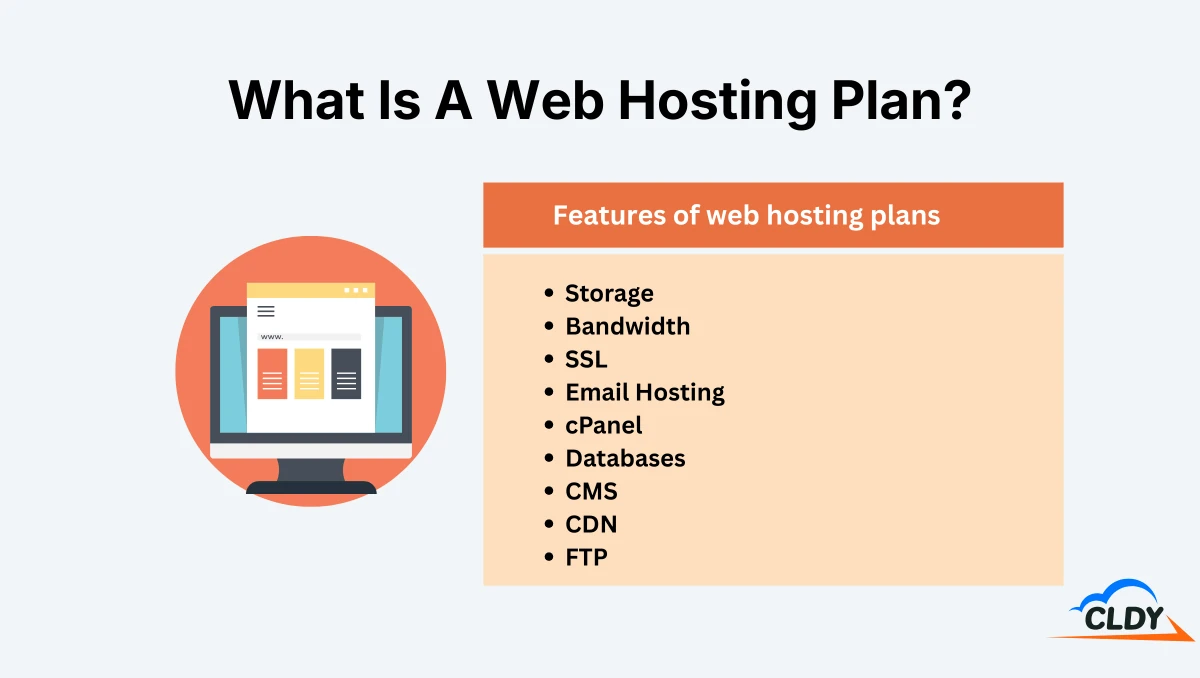
9 features of web hosting plans are listed below.
- Storage
- Bandwidth
- SSL
- cPanel
- Database
- CMS
- CDN
- FTP
Storage
Storage is a web hosting plan feature that refers to the amount of server space allocated for storing website files, databases, emails, applications, and backups. Website content, such as HTML files, images/videos, and CSS files, is all stored within the hosting account storage allocation. Hosting providers usually offer faster storage devices like SSD (Solid-State Drive) and NVMe (Non-Volatile Memory Express) to improve website loading speed and data access performance.
Bandwidth
Bandwidth is a web hosting plan feature that refers to the maximum amount of data transferred between a website’s server and its visitors’ devices within a specific period (usually a month). It dictates how much traffic and content your site handles without causing load delays or downtime. Hosting plans may provide limited, metered, or unmetered bandwidth depending on the provider’s infrastructure and usage policies.
SSL
SSL (Secure Sockets Layer) is a web hosting plan feature that refers to a security protocol that encrypts the connection between a user's web browser and the web hosting server. It ensures that sensitive data like passwords, personal details, and credit card numbers cannot be intercepted by hackers while in transit. Most hosting plans now include free SSL certificates.
Email is a web hosting plan feature that refers to the backend service that stores, sends, and receives electronic mail using a custom domain name (e.g., [email protected]). It gives professional, branded email accounts managed through a hosting provider. Email hosting features may include inbox storage, spam filtering, forwarding, autoresponders, webmail access, SMTP (Simple Mail Transfer Protocol) configuration, and email authentication.
cPanel
cPanel (Control Panel) is a web-based control panel that provides a graphical interface and automation tools to simplify website and server management. It eliminates the need for advanced technical or coding skills, allowing users to easily manage files, domains, databases, and email accounts through a standard web browser. Some Linux-based hosting providers include cPanel as part of their hosting plans because it reduces technical complexity for users.
Database
Database is a web hosting plan feature that is an organized electronic collection of information stored on a server that allows a website to dynamically store, retrieve, and manage data. It acts as the "backbone" or "filing cabinet" for a site, holding essential content like user profiles, product catalogs, and blog posts separately from the website's layout files. Hosting plans typically support database systems such as MySQL, MariaDB, or PostgreSQL. The number of databases and database resource limits depends on the hosting plan configuration.
CMS
CMS (Content Management Systems) in web hosting plans refers to software applications that allow you to build, manage, and publish a website without needing to code from scratch. Common CMS platforms include WordPress, Joomla, and Magento. It serves as the user-friendly interface sitting on top of your web server, storing text, images, and design layouts in a centralized database. Hosting plans commonly include 1-click CMS installation tools, optimized server configurations, automatic updates, caching systems, and compatibility support for popular CMS platforms.
CDN
CDN (Content Delivery Network) is a web hosting plan feature that offers a globally distributed group of servers that caches copies of a website's static files like images, CSS, and JavaScript. Instead of all visitors requesting data from the main hosting server, the CDN serves them from the server physically closest to their location, drastically speeding up load times. Hosting providers often include built-in integration with CloudFlare or proprietary CDNs in their hosting plans to improve global website performance.
FTP
FTP (File Transfer Protocol) is a web hosting plan feature that is a standard network protocol used to move website files between a local computer and a web hosting server. In web hosting, it allows users to easily upload, download, edit, and manage their site's codebase, images, and other assets in bulk. Most hosting plans provide FTP account access with authentication credentials for secure file management.
How Much Does Web Hosting Cost?
Web hosting cost varies by hosting plan, hosting type, server resources, and included features. The price of a web hosting plan usually depends on how much storage, bandwidth, processing power, management support, and performance capacity are allocated to the hosting account.
Many web hosting providers offer discounted introductory pricing for first-time customers, followed by higher renewal pricing after the initial billing term. Hosting costs also vary based on billing cycles such as monthly, annual, or multi-year plans.
How Do I Buy A Web Hosting Plan?
You buy a web hosting plan from a web hosting provider. The web hosting plan buying process involves four steps. Firstly, identify your website’s requirements. Your website size, expected traffic, application type, storage needs, performance expectations, scalability requirements, and technical management preferences all affect the type of hosting plan needed to support it.
Secondly, compare hosting types such as shared hosting, VPS hosting, and dedicated hosting. Each web hosting type offers different levels of performance, resource allocation, flexibility, and pricing.
Thirdly, choose a web hosting provider. Buyers usually compare providers based on uptime reliability, server performance, data center locations, support availability, included features, security tools, scalability options, and pricing structure.
Fourthly, select a hosting plan, create an account and choose a billing cycle. Many providers offer monthly, yearly, or multi-year payment options. You may also register a new domain name or connect an existing domain during checkout.
After you buy a web hosting plan, the hosting provider activates the hosting account and provides access credentials for the hosting dashboard or control panel. You then configure DNS settings, upload website files, install a CMS, create email accounts, and launch the website online.
What Is A Web Hosting Provider?
A web hosting provider is a company that rents out space and resources on secure, powerful computers (servers) to customers looking to publish a website or web application. The web hosting provider packages and sells web hosting plans that allocate server resources such as storage, bandwidth, CPU power, RAM, security tools, and management features to customers. These hosting plans are designed for different website sizes, traffic levels, and technical requirements.
Different web hosting providers offer different hosting resources and service models. Some providers focus on low-cost shared hosting, while others provide VPS hosting, cloud hosting, dedicated servers, managed hosting environments, or enterprise-level infrastructure solutions. Providers offer convenience to users who rent ready-to-use hosting infrastructure instead of buying servers, maintaining hardware, configuring networks, and managing the full server environment themselves.
Web Hosting Overview FAQs
Web Hosting Overview FAQs include the importance of web hosting, the feasibility of self-hosting, and the differences between web hosting and related internet services such as WordPress hosting, email hosting, website builders, and cloud storage.
Is Web Hosting Necessary For A Website?
Yes, web hosting is necessary for a website. A website consists of files, databases, applications, and media content. These must be stored on an internet-connected server for a website to be publicly accessible on the internet. Without web hosting, website files cannot be continuously accessed online.
Can I Spin Up My Own Web Server?
Yes, you can spin up your own web server instead of purchasing hosting from a web hosting provider. A self-managed web server runs on personal hardware, enterprise infrastructure, colocated servers, or cloud computing platforms. You are responsible for server setup, security, updates, uptime, backups, performance, networking, and troubleshooting.
What Is The Difference Between Web Hosting And WordPress Hosting?
The difference between web hosting and WordPress hosting is that web hosting is a general hosting service for all types of websites, while WordPress hosting is a type of hosting specifically optimized to support WordPress websites. WordPress Hosting typically includes specialized features like 1-click WordPress installation, automatic WordPress updates, and WordPress-focused security configurations.
What Is The Difference Between Web Hosting And Email Hosting?
The difference between web hosting and email hosting is that web hosting stores and delivers website content, while email hosting manages email services and mail server functionality. Email hosting allows users to send, receive, store, and manage email through addresses using their domain name.
What Is The Difference Between Web Hosting And Website Builder?
The difference between web hosting and a website builder is that web hosting provides the server for storing and delivering websites, while a website builder is a software platform used to design and create websites. Certain web hosting providers include website builders as a bonus feature to help design and launch a new website fast.
What Is The Difference Between Web Hosting And Cloud Storage?
The difference between web hosting and cloud storage is that web hosting provides the server space, processing power, and bandwidth needed to publish a website or application on the internet. Cloud storage is simply a secure, remote location used for storing, backing up, and accessing personal or business files like documents and media without using your local hard drive.