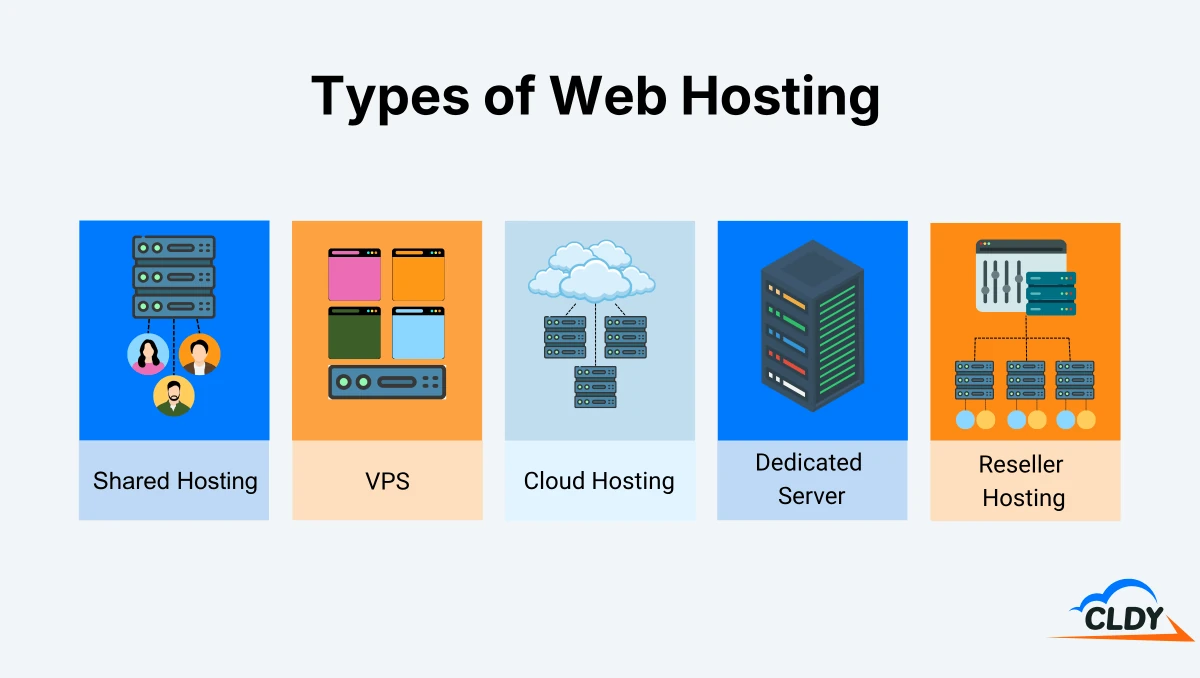
1. Shared Hosting
Shared hosting is a type of web hosting service where multiple websites share the same physical server and its resources, including Central Processing Unit (CPU), Random Access Memory (RAM), and HDD or SSD storage. Each website operates within its own allocated partition on that shared environment while the shared hosting provider manages the server infrastructure.
The key advantage of shared hosting is its low cost, with shared hosting plan prices typically starting from a few dollars per month. The low price comes from providers spreading operating costs and server resources across multiple accounts and passing these cost savings on to the customer. This means shared hosting remains the most affordable entry point into web hosting and the most accessible option for individuals and small businesses launching their first website.
The key disadvantage of shared hosting is resource oversubscription, which refers to the practice of allocating more virtual resource capacity to user accounts than the server is able to physically deliver, based on the assumption that not all users require peak usage simultaneously. For the user, this means their website performance may be affected when a neighbouring website experiences a traffic surge or requires high CPU and RAM usage. This results in slower website loading times or temporary downtime for all sites on the shared server.
Shared hosting is offered as managed hosting by default. Managed hosting means the hosting provider handles server-level maintenance such as hardware upkeep and basic security patches, while the user remains responsible for managing their own website, website software updates, and backups.
Shared hosting’s affordability and simplicity make it best suited for bloggers, freelancers, and small businesses that are building a new website, expect low to moderate traffic, and do not require dedicated server resources or advanced technical configurations.
2. Virtual Private Server (VPS)
A Virtual Private Server (VPS) is a type of web hosting service where a single physical server is partitioned into multiple isolated virtual environments, each allocated a dedicated share of the server's CPU, RAM, and storage. The two defining attributes of VPS hosting are resource isolation and root-level access. Resource isolation enables each virtual environment to operate independently from others on the same machine. Root-level access gives users full administrative control over their virtual server.
The key advantage of VPS hosting is its performance consistency. Unlike shared hosting where resources are shared among all users on the server, a VPS guarantees a fixed allocation of CPU and RAM exclusively for that account. This means website performance remains stable and predictable regardless of the activity of other virtual environments on the same physical machine.
The key disadvantage of VPS hosting is its high technical complexity. Managing a VPS requires a working knowledge of server administration, including configuring the operating system, installing software, managing security patches, and troubleshooting server-level issues. Without this technical capability, VPS users risk misconfiguring their environment or leaving their server exposed to security vulnerabilities.
VPS hosting is available in both managed and unmanaged forms. Managed VPS transfers server administration responsibilities to the hosting provider, while unmanaged VPS gives technically proficient users complete control over their server environment. This makes VPS hosting best suited for growing businesses and developers who have outgrown shared hosting and require more consistent performance and greater control, but are not yet at a scale that justifies the cost of a fully-dedicated server.
3. Cloud Hosting
Cloud hosting is a type of web hosting service where a website is hosted across a network of interconnected virtual servers that draw resources dynamically from a shared pool of underlying physical infrastructure. The defining attribute of cloud hosting is its distributed architecture, which eliminates reliance on any single physical server and enables high scalability.
The key advantage of cloud hosting is its resource scalability. Because resources such as CPU, RAM, and storage are drawn from a large pool of virtual infrastructure, cloud-hosted websites automatically scale their resource allocation up or down in real time based on traffic demand. This means a business experiencing a sudden traffic spike does not face downtime or performance degradation, as additional resources are provisioned automatically without migrating to a new server.
The key disadvantage of cloud hosting is its variable cost. Cloud hosting is often billed on a pay-as-you-use model, meaning costs fluctuate based on actual resource consumption. For businesses with unpredictable or rapidly growing traffic, cloud hosting’s variable costing makes monthly expenditure difficult to forecast and results in unexpectedly high bills if resource usage is not monitored closely.
Cloud hosting is available in both managed and unmanaged forms. Managed cloud hosting offloads server configuration, software stack, and security to the provider, while unmanaged cloud hosting gives technical teams full control over those elements. This makes cloud hosting suitable for a wide range of users, from growing small and medium-sized enterprises (SMEs) that need reliable performance without the complexity of server management, to development teams and larger businesses that require flexible, scalable infrastructure to support high-traffic applications and expanding digital operations.
4. Dedicated Server
A dedicated server is a type of web hosting service where an entire physical server is allocated exclusively to a single user or organisation, with no sharing of CPU, RAM, storage, or network resources with any other account. The two defining attributes of dedicated server hosting are exclusive resource ownership and maximum configurability. Exclusive resource ownership means every hardware component on the machine is reserved solely for a single tenant. Maximum configurability gives users complete control over the server's operating system, software stack, and security environment.
The key advantage of a dedicated server is its reliable and raw performance. Because all server resources are exclusively available to a single website or application, there is no resource sharing from neighbouring accounts. This translates directly into consistently high performance, faster processing speeds, and the ability to handle large volumes of concurrent traffic without change in performance. This makes dedicated server hosting the most powerful hosting environment available in standard web hosting.
The key disadvantage of dedicated server hosting is its high cost. Leasing an entire physical server commands a significantly higher monthly expenditure compared to shared, cloud, or VPS hosting. Beyond the base rental cost, users on unmanaged plans also bear the full burden of server administration, which requires hiring dedicated technical staff or a system administrator and increasing total operational costs.
Dedicated server hosting is available in both managed and unmanaged forms. Managed dedicated servers allow businesses to delegate server administration to the hosting provider, while unmanaged dedicated servers suit organisations with in-house technical teams capable of handling full server management. Dedicated servers are best suited for large enterprises, high-traffic e-commerce platforms, and resource-intensive applications that demand maximum performance, complete resource-control, and a hosting environment that’s fully customizable to meet strict security, compliance, and operational requirements.
5. Reseller Hosting
Reseller hosting is a type of web hosting service where an individual or business purchases a bulk allocation of server resources from a hosting provider and redistributes those resources to their own customers as separate, independent hosting accounts. The two defining attributes of reseller hosting are white-label capability and centralised account management. White-label capability allows the reseller to brand and sell hosting packages under their own business identity. Centralised account management is where the reseller administers all client accounts from a single control panel.
The key advantage of reseller hosting is its revenue potential. By purchasing server resources at wholesale rates and packaging them into individually priced hosting plans, resellers generate a recurring income stream without owning or maintaining any physical server infrastructure. This creates a scalable business model where profitability grows as the reseller's customer base expands and the underlying hosting provider absorbs all hardware and network maintenance responsibilities.
The key disadvantage of reseller hosting is that users have limited control over the underlying infrastructure. Because the reseller operates within the boundaries set by the parent hosting provider, any server-level outages, performance issues, or policy changes made by the provider directly impact the reseller's customers. This means the reseller carries customer-facing accountability for service quality without having direct control over the infrastructure delivering that service.
Reseller hosting is typically sold as managed hosting, as the parent hosting provider handles all hardware and network maintenance, while the reseller is responsible for managing their own clients' accounts, billing, and support. Reseller hosting is best suited for web designers, web developers, and digital agencies that host multiple client websites. Reseller hosting helps to consolidate account management, reduce per-site hosting costs, and build a supplementary revenue stream.
How Do I Choose A Hosting Type for My Website?
Choose a hosting type for your website by assessing 10 key website needs and matching them to the capabilities of each hosting type. First, estimate your website’s storage and bandwidth needs. Small websites with low storage and bandwidth needs suit shared forms of hosting, while media-heavy websites (large image galleries, video content) require hosting types with more generous or dedicated resources. Second, assess your website performance needs (uptime and speed). A high-traffic website needs a hosting type that supports stable uptime and fast page load speeds even under concurrent visitor loads. Third, assess any scalability requirements. The right hosting type allows you to easily upgrade resources as your website grows without demanding a full server migration. Fourth, consider if your preferred control panel is included in your hosting. Fifth, confirm the hosting type supports the security level required. Basic security tools such as SSL (Secure Sockets Layer) certificates, firewalls, and malware scanning are included across most hosting types. Websites requiring high-level security or compliance require hosting types with root access. Sixth, check the hosting’s available support channels (live chat, ticketing, phone). Seventh, review included email features and the number of mailboxes. Eighth, assess the software ecosystem supported by your hosting, including software and script support, database support and any one-click installers. Ninth, evaluate the host’s available server location options and whether they align with your website audience location. Tenth, check if your preferred CMS (Content Management Systems) is supported or pre-installed, particularly if you require e-commerce features like payment gateways, shopping carts and inventory management.
Choose shared hosting if you are launching a new business website or personal blog with low traffic, because of its low cost and low technical barriers. Choose VPS hosting if you are running a growing e-commerce store or web application because of its guaranteed resource allocation and server customizability. Choosing the right hosting type is a critical step in understanding how to choose web hosting that supports your needs without making you pay for more capacity than you need. Beyond choosing a hosting type itself, assess the needs for a managed or unmanaged service since this directly impacts how much technical involvement is required.
Managed Hosting vs Unmanaged Hosting: What Is the Difference?
The difference between managed hosting vs unmanaged hosting lies in how much server responsibility you retain. Managed hosting holds the hosting provider responsible for handling server administration tasks (server updates, security patches, and performance monitoring). Managed hosting therefore provides a hands-off experience for the website owner. Unmanaged hosting places full server responsibility on the website owner by delivering unrestricted server access. Unmanaged hosting therefore gives technically proficient users complete freedom to configure and maintain their environment to any specification.
Managed hosting is the practical and sufficient choice for most website owners because it removes server-level complexity without compromising website performance or reliability. Unmanaged hosting is warranted only in complex project scenarios. Examples of complex project scenarios include multi-stack applications, team-developed systems requiring full environment control, projects with custom or version-specific dependencies, and diverse service integrations beyond the scope of managed hosting environments.