
What Is Email Hosting?
Email hosting is a type of hosting service that allows individuals and businesses to create and manage email accounts using their own domain name. This allows users to create professional email addresses such as [email protected] instead of addresses that use free email domains such as @gmail.com or @yahoo.com. Using a custom domain strengthens brand recognition and presents a more professional image in business communications.
Email hosting is typically purchased through a monthly or annual subscription based on factors such as the number of users, mailbox storage, and included features. Email hosting providers operate mail servers that send, receive, and store emails on behalf of their customers. They are responsible for managing the server uptime, spam filtering, security, and storage capacity for each account on the server.
What Is the Difference Between Email Hosting and Web Hosting?
The difference between email hosting and web hosting lies in their purpose and infrastructure. Email hosting has dedicated servers for storing and managing email accounts, messages, and attachments only. Web hosting stores all the files necessary for a website or application, including HTML (HyperText Markup Language), images, and databases, and delivers them to website visitors through a browser.
Certain web hosting plans include free email hosting as a secondary feature, but these forms of email hosting have limited storage, security, and functionalities compared to dedicated email hosting. Dedicated email hosting providers design a separate infrastructure for mail traffic to improve email service and reduce the chance of messages being marked as spam.
What Is the Difference Between Email Hosting and Domain Hosting?
The difference between email hosting and domain hosting lies in their storage and management. Email hosting creates, stores, and manages email accounts for your brand that use your custom domain name, such as [email protected]. Domain hosting registers and manages your domain name, which is the custom web address people use to access your website, such as yourcompanyname.com.
A domain provides the address people use to find a website, but the domain alone does not host website content or send and receive email. Email hosting connects to the domain through DNS records to route messages correctly. Businesses need both services together to operate a working email address on their own domain.
What Are the Different Types of Email Hosting?
Different types of email hosting refer to the different service models used to provide, allocate, and manage the mail server resources needed for business email. The 3 different types of email hosting are shared email hosting, dedicated email hosting, and cloud email hosting.
What Is Shared Email Hosting?
Shared email hosting is a type of email hosting service where multiple user accounts share a single email server. The shared server is responsible for sending, receiving, and storing emails for all businesses simultaneously.
In shared email hosting, service providers allocate a portion of server resources (storage, bandwidth, and processing power) to each business based on the plan purchased. Shared email hosting performance decreases when server demand increases, as all accounts compete for the same resources. Spam or blacklisting issues on one account affect the server's IP reputation, impacting deliverability for all accounts on that server.
Shared email hosting is suitable for small businesses and individuals who have low email volume and limited budgets. Setting up shared email hosting does not require any technical knowledge, as the service provider is responsible for server maintenance, security updates, and server uptime.
What Is Dedicated Email Hosting?
Dedicated email hosting is a type of email hosting service where a single business rents a dedicated email server for sending, receiving, and storing emails
In dedicated email hosting, the server's resources are reserved for one exclusive user. This provides high and consistent performance and better control over email services. Dedicated email hosting improves email deliverability and allows businesses to configure advanced security settings, storage limits, and email policies to meet their unique operational requirements.
Dedicated email hosting is suitable for medium-sized and large businesses that send or receive a high volume of emails or require better reliability, security, and control over their business communications. Dedicated email hosting costs more than shared email hosting because the business pays for an entire email server. The hosting provider or an in-house IT team is responsible for managing the server, maintaining security, and ensuring reliable email service.
What Is Cloud Email Hosting?
Cloud email hosting is a type of email hosting service where email accounts are stored and managed on a network of remote servers accessed through the internet (“the cloud”). These remote servers handle sending, receiving, and storing emails for all connected accounts using shared cloud infrastructure that is distributed across multiple server locations.
In cloud email hosting, the email hosting provider distributes email data, including messages, attachments, and account settings, across multiple servers. This distribution provides uninterrupted access to the server even if one server goes offline. Cloud email hosting performance remains consistent with increasing email volume because server resources scale automatically based on demand without requiring hardware changes. Cloud email hosting is suitable for businesses that need flexible capacity and high availability as their number of users, mailbox storage, or email traffic changes.
How Does Email Hosting Work?
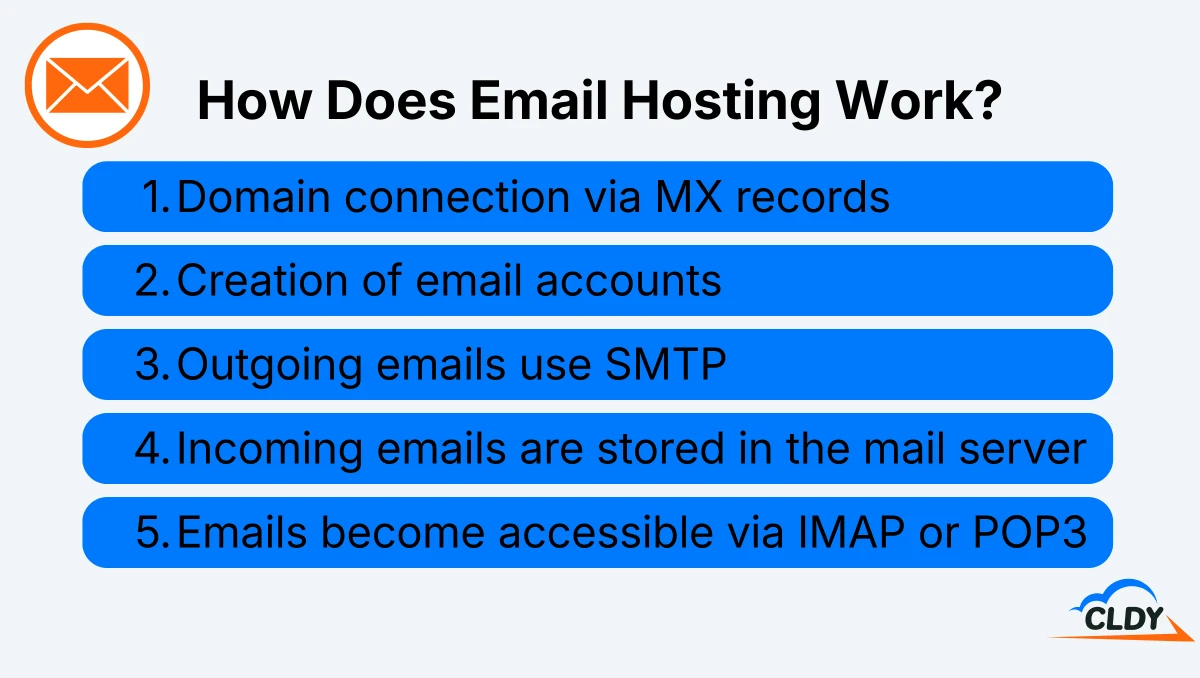
Email hosting works through the 5 main components listed below.
- Domain Connection: The business connects its domain name to the email hosting server by adding MX (Mail Exchange) records to the domain's DNS settings. MX records direct incoming email traffic to the correct mail server assigned by the email hosting provider.
- Account Creation: The email hosting provider creates individual email accounts for each user on the mail server under the connected domain, such as [email protected]. Each account receives an allocated portion of server storage and resources based on the hosting plan.
- Email Sending: The mail server uses SMTP to send outgoing emails from the business's email address to the recipient's mail server. The recipient's DNS settings identify the correct destination server for delivery.
- Email Receiving: Incoming emails arrive at the business's mail server and are stored in the assigned account. Incoming emails arrive at the business’s mail server through SMTP and are stored in the assigned mailbox. Users then access the stored messages through an email client like Outlook or Thunderbird using IMAP or POP3.
- Email Access: The email client connects to the mail server using IMAP or POP3 protocols to retrieve and display stored messages. IMAP syncs emails across multiple devices in real time, while POP3 downloads emails to a single device and removes them from the server.
A summary of these email hosting components is shown in the figure below.
Does Singapore Email Hosting Come With .SG Domain Name?
No, Singapore email hosting does not come with a .SG domain name by default. Most email hosting providers offer email hosting and domain registration as separate services. Businesses are able to purchase a .SG domain name from an accredited domain registrar and then connect it to their email hosting server through MX records in their domain registrar's DNS settings.
Is a .SG Domain Name Important for Business Email Hosting?
Yes, a .SG domain name is important for business email hosting in Singapore because it is a strong signal for local credibility and trust to customers and partners. Businesses use a .SG domain to establish a professional local identity in their email address, such as [email protected]. .SG domain names are administered by the Singapore Network Information Centre (SGNIC) and are subject to local presence and registration requirements that vary by extension. For example, .com.sg is primarily intended for commercial entities, while second-level .sg domains have broader eligibility rules. This local association can help a business present a recognisably Singapore-focused identity.
What Are the Benefits of Using Email Hosting for Business?
There are 4 benefits of using email hosting for business. The first benefit is increased credibility with customers. A custom domain email address shows that emails come from an established business, making customers more likely to trust and respond to them. The second benefit is better deliverability of emails, which means a lower risk of emails being flagged as spam by recipient mail servers. The third benefit is stronger email security due to server-level features such as encryption, spam filtering, and multi-factor authentication. Dedicated mail servers reduce the risks of phishing attacks and unauthorized access compared to free email services that share infrastructure across millions of consumer accounts. The fourth benefit is that businesses have higher control over their email accounts. Businesses create, modify, and delete mail accounts, set storage limits, and configure email policies from one central dashboard.
How Does Business Email Hosting Improve Email Deliverability?
Business email hosting improves email deliverability by assigning powerful servers for the sole task of email management. The dedicated servers have clean IP reputations because they handle email traffic for one business only and this reduces the risk of the email being flagged as spam. Email hosting providers configure authentication protocols such as SPF (Sender Policy Framework), DKIM (DomainKeys Identified Mail), and DMARC (Domain-based Message Authentication, Reporting and Conformance) on the mail server to verify the sender's identity to recipient mail servers. Recipient mail servers use these authentication records to confirm that incoming emails are being received from a legitimate source.
Can Email Hosting Protect My Business From Spam and Phishing?
Yes, email hosting can protect your business from spam and phishing through server-level security features that are applied to all incoming and outgoing email traffic. Email hosting servers use spam filters to scan incoming emails for known spam patterns, malicious links, and suspicious sender behavior before delivering them to the recipient's inbox. Emails that are identified as spam are quarantined or rejected at the server level and do not reach business accounts.
Email hosting protects against phishing attacks by implementing authentication protocols such as SPF, DKIM, and DMARC on the mail server. These protocols verify the identity of incoming senders, reject emails that fail authentication checks, and block spoofed emails that impersonate trusted senders.
How Does Professional Email Build Customer Trust?
A professional email builds customer trust by presenting a verified business identity in every communication. Customers associate free email addresses such as gmail.com or yahoo.com with personal use rather than professional business communication. A branded email address, such as [email protected], makes the receiver think that the sender is a legitimate, established business instead of an individual. Customers are therefore more likely to open, respond to and take action on emails from a recognizable business email address compared to a generic free email account.
How Much Does Email Hosting Cost?
Email hosting costs between $1 and $60 per user per month. The 5 main factors that affect the price of email hosting are given below.
- Number of Accounts: The number of accounts on an email hosting server directly affects the price, as email hosting providers charge on a per-user, per-month pricing model. The total monthly cost increases with the number of email accounts a business requires, so larger teams pay a higher total monthly cost even on lower per-user pricing plans.
- Mailbox Storage: Mailbox storage determines the amount of data that each email account stores on the server, which directly affects the plan tier and cost. Email hosting plans offer between 5 GB and 25 GB of storage per user. Businesses that need larger storage, like in terabytes or strong email archiving, pay more for premium or enterprise-grade plans.
- Bundled Software Tools: Bundled software tools like calendar, document editing, and video conferencing increase the per-user monthly cost of email hosting. Standalone email hosting costs less because it includes only core email services.
- Security and Compliance Features: Security and compliance features determine the level of protection applied to business email accounts on the hosting server. Basic email hosting plans include standard spam filtering and antivirus protection. Advanced features such as Data Loss Prevention (DLP), multi-factor authentication, and end-to-end encryption are reserved for higher-tier or enterprise plans.
- Email Hosting Type: Email hosting type determines the infrastructure cost of an email hosting plan because each type allocates server resources differently. Shared email hosting is the cheapest because multiple businesses share the same resources. Cloud email hosting is priced in the mid-range and dedicated or self-hosted email hosting costs the most because the entire server is used by one business.
How Much Does Business Email Hosting Cost?
Business email hosting refers to email hosting services catered to the needs of businesses. Business email hosting costs start between $1 and $8 per user per month, depending on the number of mailboxes and storage capacity that the company requires in a plan. A business email hosting plan requires a separate mailbox for each purpose and each employee. Every business needs a minimum of 3 mailboxes to operate professionally, including an employee name mailbox for direct communication, a finance mailbox for billing and accounting, and a customer support mailbox for handling client inquiries. The total monthly cost of the plan increases with each additional mailbox and storage requirement added.
What is the Cheapest Way to Get Email Hosting for a Small Business?
The cheapest way to get email hosting for a small business is by signing up for an email hosting plan through a web hosting provider. Web hosting providers allocate storage into smaller individual mailboxes that businesses assign to a specific purpose without paying for a large account with unnecessary features. A small business pays only for the mailboxes and storage it actively uses, which keeps the monthly cost low. CLDY offers email hosting plans starting from $1 per mailbox per month, giving small businesses an affordable way to use professional business email.
How Do I Set Up Email Hosting?
Follow 6 steps to set up email hosting. First, register a domain name through a domain registrar to create a custom email address for the business. Second, sign up for an email hosting plan that matches the number of mailboxes and storage capacity required. Third, configure the domain's DNS settings by adding the provider's MX records to direct incoming email traffic to the assigned mail server. Fourth, set up the mail server's settings, like SMTP, IMAP, or POP3 protocols, to enable sending and receiving mail. Fifth, create mailboxes and aliases for each employee and business function. Sixth, access email through a webmail interface or a mail client such as Outlook or Thunderbird.
How Do I Create a Professional Email Address?
Create a professional email address by using a common format such as [email protected], where the person's first and last name appear before the custom domain name. Businesses use this format to identify the sender clearly and maintain a consistent email naming structure across all employee accounts. A consistent email format also makes it easier for clients and business partners to identify and remember individual contacts within the business. Avoid using nicknames, numbers, or random characters in a professional email address, as they reduce credibility and make the sender harder to identify.
Is Migration Service Available with CLDY Email Hosting?
Yes, an email migration service is available with CLDY email hosting for a one-time fee of $50. The migration service transfers existing email data, including messages, folders, and account settings, from the current email provider to the CLDY mail server. The migration process preserves all existing emails, folders, and account settings to allow businesses to continue using their email without needing to recreate their accounts.