What Is a Domain Name?
A domain name is a unique string of text that maps to an Internet Protocol (IP) address. It serves as the unique online address of a website, allowing users to find, access, and identify the website on the internet. A domain name is the human-readable alternative to a numerical IP address, which makes websites much easier to remember and visit. A domain name acts as a shortcut to a website's IP address. When someone enters a domain name into a web browser, it directs the browser to the correct web server hosting the website.
For example, instead of entering an IP address such as 172.67.74.42 into a web browser, a user simply needs to type cldy.com. The domain name cldy.com maps to the website's IP address, making it much easier to remember and access.
How Does a Domain Name Work?
A domain name works by linking a human-readable website address to the Internet Protocol (IP) address of the web server that hosts the website. Computers locate websites using numerical IP addresses, such as 101.127.0.0, while people use domain names because they are easier to remember. The Domain Name System (DNS) connects the domain name to its corresponding IP address and directs the browser to the correct web server.
The 4 steps showing how a domain name works are given below.
- Input: A user enters a domain name, such as example.com, into a web browser.
- Lookup: The browser sends a request to the DNS to find the IP address associated with the domain name.
- Translate: The DNS returns the corresponding Internet Protocol (IP) address for the domain name.
- Route: The browser uses the IP address to connect to the correct web server, which sends the website's content back to the browser for display.
What Are the Parts of a Domain Name?
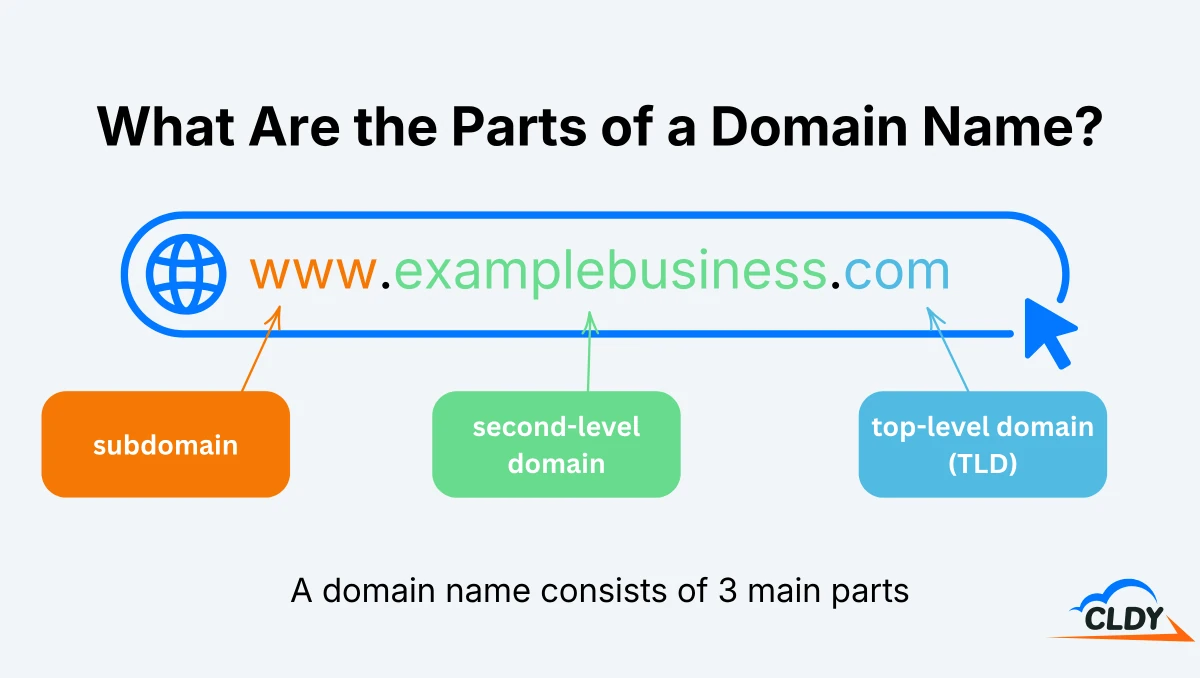
A domain name consists of 3 main parts that include the top-level domain (TLD), the second-level domain, and an optional subdomain.
The top-level domain (TLD) is the last part of a domain name and identifies the type or purpose of the website through its domain extension. Common generic top-level domains (gTLDs) include .com, .net, and .org, while country code top-level domains (ccTLDs) include .uk, .au, .ca, and .sg.
The second-level domain is the unique name registered by the website owner that identifies the website or business. In example.com, "example" is the second-level domain.
A subdomain appears before the second-level domain and is used to organize different sections or services of a website. Subdomains are optional and are only used when a website needs to separate content or services under the same domain. For example, blog.example.com and shop.example.com use subdomains ‘blog’ and ‘shop’ to direct visitors to specific parts of a website.
The figure below summarises the structure of a domain name by showing where each of these 3 parts appears.
A domain name is different from a Uniform Resource Locator (URL). A domain name identifies a website, while a URL is the complete web address used to access a specific page or resource. For example, example.com is a domain name, whereas https://www.example.com/blog is a URL.
What Is a Generic Top-Level Domain (gTLD)?
A generic top-level domain (gTLD) is an internet top-level domain that is generic and not associated with a specific country or geographic location. Generic top-level domains appear at the end of a domain name and are used by individuals, businesses, and organizations worldwide to establish a global online presence. Common examples of generic top-level domains include .com for commercial websites, .org for nonprofit organizations, .net for network-related services, and .info for informational websites.
What Is a Country-Code Top-Level Domain (ccTLD)?
A country-code top-level domain (ccTLD) is an internet top-level domain that represents a specific country, territory, or geographic region. It consists of two letters based on international country codes and appears at the end of a domain name. Common examples of country-code top-level domains include .sg for Singapore, .uk for the United Kingdom, .ca for Canada, and .au for Australia. Businesses and individuals use ccTLDs to establish a local online presence and show that their website serves users in a specific country.
What Is a Sponsored Top-Level Domain (sTLD)?
A sponsored top-level domain (sTLD) is a top-level domain that is sponsored by a specific organization, community, or industry served by the domain. Sponsored top-level domains have eligibility requirements such as membership in a professional organization, affiliation with an educational institution, government entity, or industry association. Only individuals or organizations that meet the sponsor's criteria are allowed to register sTLDs.
Common examples of sponsored top-level domains include .edu for accredited educational institutions and .gov for government organizations. These domains identify websites belonging to specific sectors or communities.
How Much Does a Domain Name Cost?
The registration cost of a domain name ranges from S$8 to S$90 per year for the first registration period. The exact registration cost of the domain name depends on the domain extension and the domain registrar. Some domain registrars offer discounted introductory prices, while certain domain extensions such as .org or .health cost more than others.
The renewal cost of a domain name is priced between S$20 and S$90 per year, according to the TLDs. Renewal prices are often higher than first-time registration prices, so it is important to compare both costs before purchasing a domain name.
Premium domain names cost significantly more than standard domain names because they are short, memorable, or contain highly desirable keywords. These domain names may already be owned by another registrant or designated as premium by the domain registry. Premium domain names cost anywhere from hundreds to millions of dollars, depending on their demand and market value.
How Do I Choose a Domain Name?
Choose a domain name that is short, memorable, and relevant to your business. A good domain name is easy to spell, reflects your brand, and supports your long-term business goals so customers easily find, remember, and share your website.
Choose a domain name by checking it meets the 10 criteria listed below.
- Short: Short domain name is easier for customers to type, remember, and share. A concise domain name reduces typing errors and improves brand recall.
- Unique: Unique domain name helps your business stand out from competitors. A distinctive domain name makes your website easier for customers to recognize and find online.
- Relevant: Relevant domain name clearly relates to your products, services, or industry. A relevant domain name helps customers immediately understand what your website offers.
- Easy to Spell: Easy-to-spell domain name reduces typing mistakes and makes your website easier to find. Simple words and clear spelling help customers enter your domain name correctly.
- Pronounceable: Pronounceable domain name is easier to say, remember, and recommend by word of mouth. Clear pronunciation also reduces confusion when your domain name is shared verbally.
- Brandable: Brandable domain name is distinctive, memorable, and reflects your brand identity. A strong brandable domain name makes your business more recognizable and supports long-term brand building. If you need ideas, use a domain name generator to brainstorm brandable domain names that match your business or industry.
- Descriptive: Descriptive domain name gives visitors an immediate idea of what your business does. A domain name that describes your products, services, or industry helps customers understand your website before they visit it.
- Keyword-Rich: Keyword-rich domain name helps users understand your website's purpose and reinforces its relevance for search engines. Add relevant keywords only when they fit naturally within your brand name and do not reduce readability or memorability.
- Memorable: Memorable domain name is easier for customers to recall after visiting your website. A memorable domain name encourages repeat visits and increases the chances of word-of-mouth referrals.
- Future-Proof: Future-proof domain name supports your business as it grows. Choose a domain name that is broad enough to accommodate future products, services, or markets so it remains relevant as your business expands.
How Do I Check a Domain Name Availability?
Check a domain name's availability by using a domain name search tool provided by a domain registrar or web hosting provider. You simply enter your preferred domain name into the search tool to see whether it is available for registration.
If the domain name is already registered, use a WHOIS lookup to check its registration status, registrar, expiration date, and other publicly available registration details. This helps you confirm whether the domain is already in use and identify information about its registration.
How Do I Register a Domain Name?
Register a domain name by choosing an available domain name and selecting an accredited domain registrar or a web hosting provider that offers domain name registration services to complete the registration process. First, you need to search for your preferred domain name and confirm that it is available for registration. Try a different domain extension if it is unavailable or modify the domain name until you find an available option. Second, select a reputable domain registrar or web hosting provider, such as CLDY, to register and manage your domain name. Third, compare registration fees, renewal prices, domain management features, and customer support before making your decision. Fourth, buy the domain by entering the required registrant information, choosing the registration period, and completing the purchase.
Once your registration is successful, the domain name is reserved for your use. Register your preferred domain name as soon as possible after confirming its availability. Timely registration reduces the risk of domain squatting (cybersquatting), where someone registers a domain name to profit from or take advantage of an established brand or trademark.
Many people who are registering a domain name also ask, "What is a domain name registrar?" A domain name registrar is a company accredited to register and manage domain names such as CLDY, GoDaddy, and Namecheap. A domain name registrar allows you to search, register, renew, and manage domain names.
How Do I Register a .sg Domain Name?
Register a .sg domain name through a registrar accredited by the Singapore Network Information Centre (SGNIC). Search for your preferred .sg domain name to confirm that it is available. Then, complete the registration through an accredited registrar by providing the required registrant information and paying the registration fee. Once the registration is complete, you can manage your .sg domain through your registrar, including renewing the registration, updating DNS records, and connecting it to your website or email services.
Can I Register Multiple Domain Names?
Yes, you can register multiple domain names for the same business. Businesses register multiple domain names to protect their brand, target different markets, support separate websites, or prevent competitors and cyber squatters from registering similar domain names.
For example, a business may register company.com, company.sg, company.net, and common misspellings of its brand name. All of these domain names point to the same website or be used for different websites, depending on the business's needs.
Domain Name FAQs
Frequently Asked Questions (FAQs) on domain names cover the difference between domain and hosting, domain name importance, and domain name ownership.
Domain Name vs. Web Hosting: What Is the Difference?
A domain name is your website's address that visitors type into their web browser, while web hosting is the service that stores your website's files and makes them available online. The difference between a domain name and web hosting is that a domain name identifies and directs visitors to your website, while web hosting stores and delivers the website's files. A domain name and web hosting are both required to publish a website on the internet.
Why Is a Domain Name Important for Businesses?
A domain name is important for businesses because it serves as the business's digital address and establishes a professional online identity. It makes it easier for customers to find, recognize, and trust the business, providing a long-term digital asset that supports its online presence.
Using a custom domain also allows businesses to create professional email addresses, such as [email protected], which creates a more credible and professional impression than free email services.
Can a Website Work Without a Domain Name?
Yes, a website can work without a domain name by using its IP address or a temporary web hosting URL or by using a free subdomain provided by a website builder or hosting provider. It is not practical to host a website without a domain name because IP addresses are difficult to remember, temporary URLs appear unprofessional, and free subdomains display the provider's branding. A custom domain name makes a website easier to find, access, and trust.
Is It Possible to Own a Domain Name Permanently?
No, it is not possible to own a domain name permanently, as domain names are registered for a fixed period, between one and ten years. A domain name must be renewed before it expires to keep ownership.
Many domain owners also ask, “what happens when a domain name expires?” If a domain name expires and is not renewed, it enters a grace period during which the current registrant needs to renew it. After that grace period ends, the domain enters a redemption period during which it is allowed to be renewed with an additional penalty fee. After this time expires, the domain name becomes available for registration by someone else.